Within the Europe's Rail Joint Undertaking (ERJU), the railway sector in Europe is working to establish a harmonized Railway Area, addressing issues such as population growth, urbanization, and sustainability.
Collaboratively Hitachi, Alstom, DB, SBB,ÖBB and many other suppliers are engaged in the Innovation Pillar of the flagship project R2DATO, which aims to transform railway operations through automation and digitization to meet the demands for greater capacity and efficiency.
One of the projects within this context includes a demonstrator for a future Traffic Control and Supervision system, designed to test a new geometric safety logic with the purpose of simplifying operations, accelerating planning, and increasing capacity.
Current railway safety systems use fixed points, in form of signals or marker boards, to ensure a safe operation. A train movement can only be authorized over track circuits that are not occupied. Designing an especially verifying those fixed points is labour and time consuming.
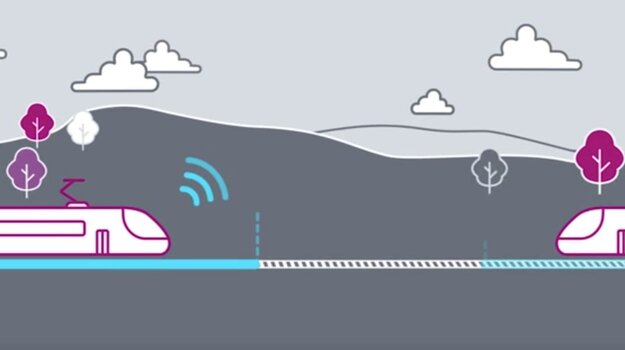
The System we will demonstrate ensures safety with a train-oriented perspective without the need of predefinded fixed points. It checks if requested movements can be allowed and either grants a request, declines it or takes safety measures.
Furthermore, the system shall allow trains using the same track circuit if they have a working train integrity monitoring system.
With the Innovation Pillar’s Demonstrator, we provide a prototypical implementation of a train-oriented safety logic. At DB´s Digital Testbed in the Ore Mountains, Germany, the functionality and benefits of the system are demonstrated for the first time.
The demonstrator´s architecture follows the current system concept of the system pillar. Its core consists of three central components: the "digital register", the "plan execution system", and the "European trackside protection system". Hitachi Rail provides both the plan execution system and the European trackside protection system. Now, let me introduce the different components. First, the digital register is responsible for the central storage and distribution of project data. Second, the plan execution system receives the timetables from a traffic management system and converts them into "movement permission requests" for individual trains. It does not have any safety responsibility, allowing for various optimizations and prioritizations to occur. Third, the European trackside protection system forms the safety core of the overall System, combining the safety functionality of todays interlocking and radio block centers. It grants "movement permissions" if all conditions for a safe journey are met. These movement permissions are then converted to authorisations sent to the train. This subsystem also includes control and management of all trackside elements such as switches, axle counters, or railway crossing safety installations.
Simulation allows testing of individual and integrated sub-systems of the Demonstrator without vehicles and trackside infrastructure. In the simulation, the trackside infrastructure and vehicles are realistically emulated in the test environment, enabling early, developmental system assurance, as well as cost-effective and risk-free test execution.
Many errors have already been detected in advance without the vehicles having to operate on the tracks. The purely virtual visualization of the subsystems allows for easy generation and execution of endurance and regression tests, which are automated with each new version.
Besides the execution in the simulation environment, the tests are also conducted in the field test environment in the Ore Mountains. The servers are connected to the field elements and vehicles. As in this case, the train rides are not simulated. A close collaboration of the testers with the on-site personel is required. Field tests are particularly necessary for components that cannot be simulated, such as transmission via FRMCS to the vehicle and control of real switches during operation.
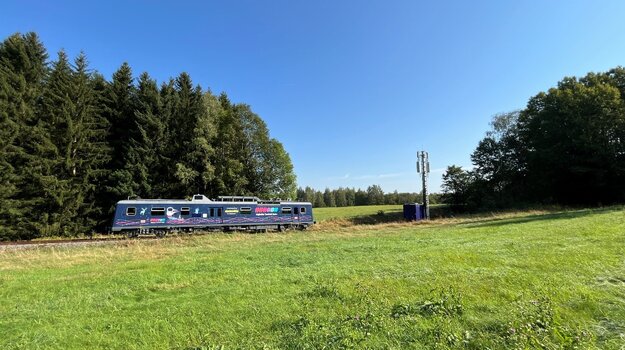
For our tests we use two vehicles. The first vehicle series 708.4, originally an overhead maintenance vehicle, is converted into a test carrier vehicle and equipped with laboratory ETCS-onboard unit for the ERJU project. The second vehicle, originally a railcar, has been converted into an ETCS test vehicle for approval and test runs. For our project, we have chosen the digital testbed in the Ore Mountains. Distinguished by its modern and future-oriented track equipment. It encompasses the latest technological standards and is equipped with relevant technologies for our project, such as EULYNX object controllers at the field elements and a modern communication infrastructure (5G/FRMCS).
Moreover, through multiple tracks in the Ore Mountains, we can demonstrate more complex scenarios like overtaking maneuvers.
The successful tests in the Ore Mountains have demonstrated that the envisioned architecture and geometric safety logic function in a real-world environment, even with today´s track circuit design. Furthermore, we have shown that it is possible to increase capacity by operating at absolute braking distances, thereby enhancing the urgently needed performance and efficiency in the railway system in cooperation with European partners.