

5G-RACOM Strengthens the Future Railway Communication System FRMCS
How can railway communications remain stable as ever-increasing volumes of data need to be transmitted in real time? The Franco-German innovation project 5G-RACOM demonstrates how hybrid FRMCS networks can provide a solution. At the heart of the project are intelligent multipath protocols that dynamically route data via both railway-owned and public mobile networks, enhancing stability, availability and resilience in digital railway operations. Extensive testing was carried out on the Digital Railway Test Field in the Ore Mountains region of Germany.
As railway operations become increasingly digital and efficient, communication infrastructure must keep pace with future requirements. A growing volume of operationally relevant information is exchanged in real time between trains and infrastructure. The existing GSM-R system, based on 2G technology, is increasingly reaching its technical limits. For this reason, the Future Railway Mobile Communication System (FRMCS) is being developed as the next-generation railway communications standard based on 5G technology. It is intended to support both safety-critical applications and data-intensive services.
This is precisely where the Franco-German research project 5G-RACOM comes into play. The project investigated how FRMCS can be made more resilient through the use of hybrid networks. The underlying concept is straightforward: the railway's dedicated communications network is complemented by public mobile networks. This creates multiple transmission paths that can be utilised according to their quality and availability. If one transmission path fails or its performance deteriorates, data traffic can automatically be redirected to an alternative route. At the same time, additional capacity can be utilised whenever larger volumes of data need to be transmitted.
This is enabled by so-called multipath protocols. Within the project, technologies were deployed that allow data to be transmitted not only via a single channel but also to be intelligently distributed, switched or aggregated across multiple paths. For the applications themselves, these transitions remain invisible. The connection is maintained while the system continuously selects the most suitable transmission path in the background. This capability is crucial for railway operations, where communication must remain reliable even under changing radio conditions.


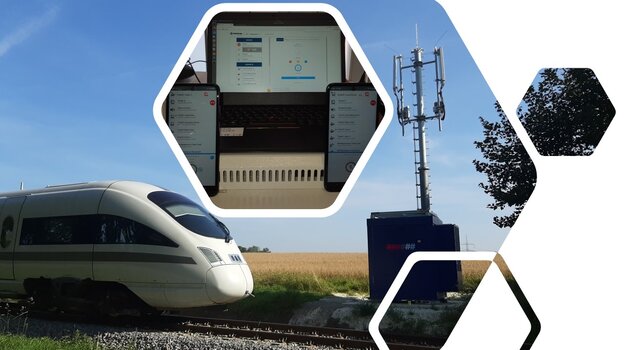
At the Digital Railway Test Field in the Ore Mountains (see figure), 5G-RACOM demonstrated how hybrid networks can further enhance the resilience of railway communications. To this end, a dedicated FRMCS test network was combined with a public 5G network to provide parallel communication paths. This ensured stable communications even under varying conditions. At the same time, the project established important technical foundations for future railway communications. The use of multipath protocols was successfully validated not only from a functional perspective but also through interoperable, multi-vendor implementations.
5G-RACOM therefore provides a tangible demonstration of how the railway communications systems of the future can become more resilient. Hybrid networks and intelligent multipath transmission are no longer merely a theoretical vision; they have been successfully demonstrated under realistic operating conditions. For DB InfraGO, this represents an important building block on the path towards a high-performance digital infrastructure, as robust communications systems are a fundamental prerequisite for modern and efficient railway operations.
Readers interested in further details can find comprehensive information on the technical concepts, project architecture and test results in the following technical publication:
5G-RACOM – Results of Multipath Protocol Tests for Hybrid FRMCS Networks, SIGNAL+DRAHT, Issue 05/2026