

Digitisation boost for the project Corridor Rhine-Alpine: first call-off from the volume contract with Alstom on the route between Ratingen and Leverkusen
With another initial call-off from the volume contract for the digitalisation of control and safety technology – this time with the contract partner Alstom – DB InfraGO is setting an important milestone in the project Corridor Rhine-Alpine: between Ratingen West and Leverkusen Morsbroich, the section of line will be equipped with the standardised Europe-wide European Train Control System (ETCS). Two Radio Block Centres (RBC) are to be set up and an integrated operating system (iBS) will be used to efficiently operate and monitor the interlockings and ETCS technology. This will strengthen European interoperability and make the rail network viable for both passengers and freight transport.
The volume contract for the digitalisation of control and safety technology, which DB has concluded with four principal contractors from the rail industry – MerMec Deutschland GmbH, Hitachi Rail, Alstom and the consortium Siemens Mobility and LEONHARD WEISS – lays the foundation for the rapid and reliable digitalisation of the German rail network. With a total volume of 6.3 billion euros, it defines fixed call-off quantities that guarantee planning security for both sides. In addition to modern interlocking technology, the contract also includes the European Train Control System (ETCS) and the integrated control and operating system (iLBS).
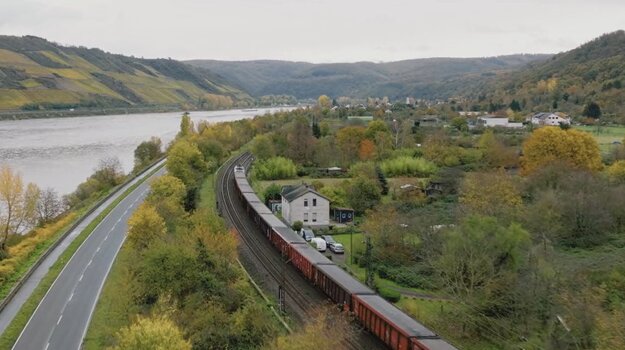
For the section of line between Ratingen West and Leverkusen Morsbroich, which connects the cities of Düsseldorf and Leverkusen on the right bank of the Rhine, DB InfraGO has initiated another initial call-off from the volume contract as part of the sector initiative Digitale Schiene Deutschland – for the first time with the contract partner Alstom. The section is part of the project Corridor Rhine-Alpine and is part of the European corridor North Sea – Rhine – Mediterranean. This central north-south axis of the trans-European transport network connects important seaports and economic areas from the Netherlands, Belgium, France, Luxembourg and Germany to Switzerland and Italy.
Scope of call-off and planned measures
As part of the initial call-off from the volume contract with Alstom, the existing intermittent automatic train protection (PZB) on the route will be expanded to include ETCS Level 2 with signals (L2mS). To this end, modern, digital interlocking technology will be implemented, balises will be relocated and two new Radio Block Centres (RBC) will be built in Düsseldorf-Rath and Solingen. Under ETCS L2, the RBC ensures continuous radio communication with the trains and is therefore a key factor for efficient and interoperable transport on the European rail network.
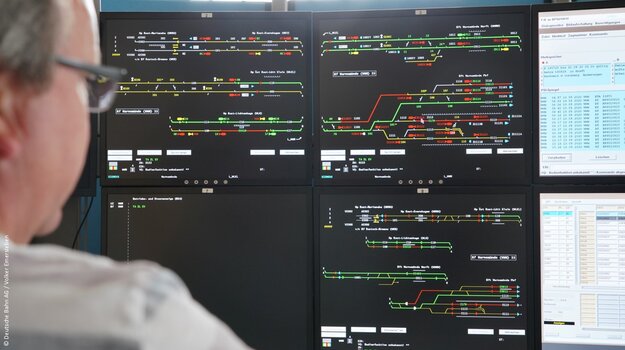
In addition, the integrated operating system (iBS) will be introduced so that the interlocking and RBC functions can be operated and monitored centrally from the digital control centre in Wuppertal in future. The iBS enables manufacturer-independent control of modern interlockings – realised via the standard interface SCI-CC (Standard Communication Interface – Command and Control). This ensures that in future all modern interlockings can be controlled according to standardised principles and processes – like how devices can be universally connected and used via a USB port on a computer. This approach offers considerable advantages over previous systems: for example, an adaptive user interface for signallers, more flexible changes of responsibility in the event of a fault and an attractive and modern workplace. The iBS thus enables modern, standardised and efficient control of interlockings – regardless of the manufacturer.
Commissioning of the first construction phase, which includes the RBC Düsseldorf-Rath and the section from Ratingen West to Immigrath, is scheduled for December 2029. During this, around 43 kilometres of track will be equipped with ETCS L2mS. This will be immediately followed by the second construction phase with RBC Solingen on the section from Opladen to Leverkusen Morsbroich, which will see a further 21 kilometres of track equipped with ETCS L2mS.
Fabian Degen, project management engineer, Corridor Rhine-Alpine technology – western sub-project, summarises the significance of the first call-off from the volume contract with Alstom for the project Corridor Rhine-Alpine:


"It is impressive to see how we are realising modern control and safety technology together with Alstom: We are thus taking another important step in the corridor towards greater interoperability in European rail transport."
Volume contract as a driver of digitalisation
Calls from the volume contract had already been made previously – the first call from the Siemens Mobility and LEONHARD WEISS bidding consortium in May 2025, followed by a further call from the consortium in January 2026 and the first call from Hitachi Rail in February 2026.
With the current call-off from Alstom, DB InfraGO is seamlessly continuing its strategic modernisation programme and significantly advancing the digitalisation of rail infrastructure in North Rhine-Westphalia and beyond. The project will increase performance, reliability and viability for the future of rail transport for passengers and freight far beyond the region and into Europe as a whole.


"The initial call-off from the volume contract is a strong signal: together with Alstom, we are consistently driving forward the ETCS rollout in Germany."
Christian Walge, Project Manager, Corridor Rhine-Alpine technology – West sub-project
Here you can find the official press release (German only).