

Digitisation boost for the north: Further call-off from the volume contract for the digitalisation of control and safety technology with Siemens Mobility and LEONHARD WEISS
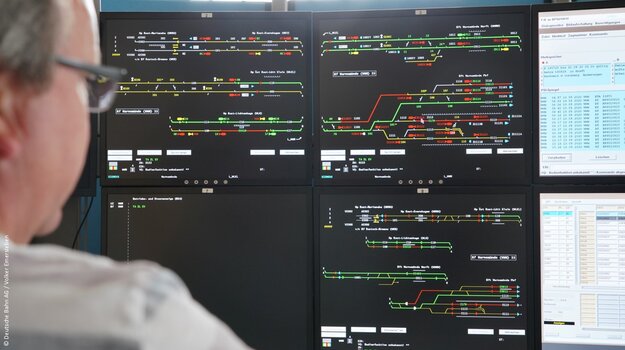
With a further call-off from the so-called “Volumenvertrag” (volume contract) with the consortium consisting of Siemens Mobility and LEONHARD WEISS, DB InfraGO is taking the next step towards digitalising the rail network in the north. Modern interlocking technology and the European Train Control System ETCS will be installed on the Lüneburg – Dannenberg and Uelzen – Stelle sections of the Corridor Scandinavian-Mediterranean (ScanMed) in Lower Saxony.
The volume contract concluded in 2024 for the digitalisation of control and safety technology obliges DB InfraGO to call up a fixed quantity of products and services for digital control and safety technology. The contractual partners are Hitachi Rail, MerMec Deutschland GmbH, Alstom and the consortium consisting of Siemens Mobility and LEONHARD WEISS. The partners deliver the requested products and services on time – so all parties involved benefit from binding planning security, accelerated coordination and award processes and rapid implementation of digitalisation projects.
The first call-off from the volume contract was made in June 2025 with the consortium Siemens Mobility and LEONHARD WEISS for the project Corridor Rhine-Alpine in North Rhine-Westphalia. This will now be followed by another call-off with the consortium – this time for the Corridor ScanMed on the Lüneburg – Dannenberg and Uelzen – Stelle sections in Lower Saxony. DB InfraGO is thus continuing its strategic approach of the volume contract as part of the Digitale Schiene Deutschland: thanks to the volume contract, the rail network is receiving a significant digitalisation boost.
As part of this call-off, the 55-kilometre stretch between Lüneburg and Dannenberg will be equipped with modern interlockings and the standardised European Train Control System ETCS. The control and safety technology on the approximately 75-kilometre section between Uelzen and Stelle will be expanded to include ETCS and some sections will be equipped with modern interlockings, new signals and point machines. In total, around 130 points and 244 signals will be connected to the new interlocking systems on both sections of line. In addition, four ETCS-control centre – so-called Radio Block Centres – and two modern interlocking central units are being built.
DB InfraGO and the consortium Siemens Mobility and LEONHARD WEISS are continuing to take a major step together to establish new standardised technologies in operation. The call-off stands for more speed in the implementation of digitisation projects and more quality in the modernisation of the German rail network. It makes the railway more efficient, reliable and viable for the future for travellers and freight transport in northern Germany – and beyond.