

For a strong European railway: Commissioning of around 60 kilometres of ETCS on the cross-border sections Germany – Switzerland
As part of Digitale Schiene Deutschland (DSD), DB InfraGO AG has put the European Train Control System (ETCS) into operation on the approximately 60 kilometres of cross-border sections Germany – Switzerland as of the 2025/26 timetable change – and thus equipped the first border crossings between Germany and a neighbouring country with this train control system on a large scale. From now on, trains with this technology can travel between Basel and Lake Constance without having to change train control systems in the neighbouring country. This will strengthen cross-border European rail transport. With this modernisation, DB InfraGO AG is implementing EU requirements: The trans-European rail system is to become more efficient and interoperable – with ETCS as a binding standard.
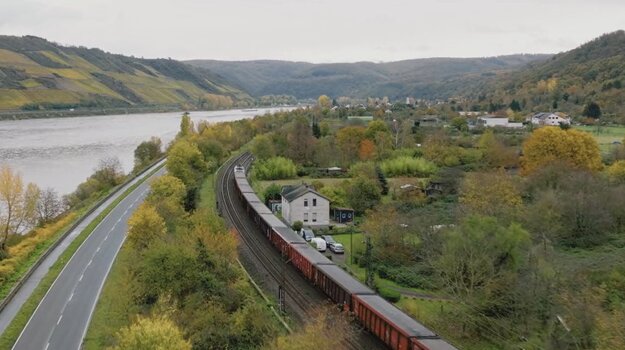
The rail networks of Germany and Switzerland are closely connected at their national border between Basel and Lake Constance. DB InfraGO AG operates the Hochrheinbahn railway along this border. It starts in Mannheim as the Rhine Valley Railway and runs southwards via Karlsruhe to Basel. From there, the line then runs eastwards as the Hochrheinbahn via Schaffhausen to Constance on Lake Constance. Between Basel and Constance, some parts of the line lie on Swiss territory – the so-called cross-border sections Germany – Switzerland. These consist of several border crossings and include:
- Basel node (13 km)
- Line between Erzingen (Baden) – Singen (Hohentwiel) (42 km)
- Tracks in Constance in the direction of Switzerland (0.4 km)
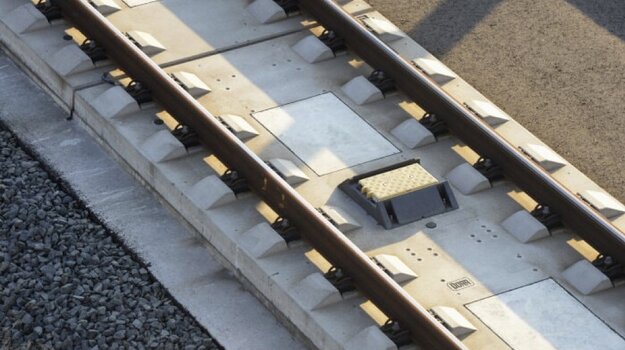
Together with the operationally necessary connection areas, a total of around 60 kilometres have now been equipped with ETCS Level 1 Limited Supervision (ETCS L1 LS). The equipment was installed as part of the "Corridor Rhine-Alpine" project, which aims to consistently equip the German section of the European TEN-T corridor "North Sea – Rhine – Mediterranean" (NSRM) with ETCS. The corridor NSRM connects central seaports and major economic centres in Ireland, the Netherlands, Belgium, France, Luxembourg, Germany, Switzerland and Italy. It is therefore one of the most important north-south axes in Europe, particularly for freight transport.


The Basel node has a special role to play here: not only is it the most important interface between the German and Swiss rail networks, it also forms the central hub in the NSRM corridor – with one of the highest passenger and freight volumes at a European border.
The importance of these connections is high – both regionally and internationally: by completing the ETCS upgrade, DB InfraGO AG and its partner, Swiss Federal Railways (SBB), are strengthening the performance and reliability of international rail transport. This paves the way for smooth and modern cross-border passenger and freight transport on one of Europe's most important railway connections.


"With the introduction of ETCS on the cross-border sections between Germany and Switzerland, we are creating a viable and interoperable rail infrastructure in the heart of Europe. In doing so, we are making a significant contribution to an efficient and reliable European railway."
Klaus Müller
Member of the Management Board for "Digital Infrastructure and Communication Technology" at DB InfraGO AG
The equipment with ETCS L1 LS was installed in addition to the national train control systems of both countries. In Germany, intermittent automatic train protection remains active, in Switzerland the EuroSIGNUM-P44 and EuroZUB-P44 systems. This dual equipment makes it possible to travel across national borders with different vehicle equipment.
Switzerland benefits particularly from the ETCS equipment, as the entire network there is already equipped with ETCS and the proportion of ETCS-only vehicles is continuously increasing. The ETCS equipment on the cross-border routes operated by DB InfraGO AG enables Switzerland to further increase this proportion.
Further construction activities and special features of the routes
In parallel with the ETCS equipment, the infrastructure of the cross-border sections between Germany and Switzerland is being further expanded to meet the growing demand for passenger and freight transport. New tracks have already been built in the southern area of the Basel Baden marshalling yard, e.g. for stabling, shunting and stabling trains (track group F). They will ensure faster and more efficient freight train transit. At the same time, new transport facilities will be built in the Basel node between Weil am Rhein and Haltingen by 2027. The construction of a new track will enable a clear separation of passenger and freight traffic. These measures will create smoother operations and increase capacity. They contribute to greater punctuality and support stable, international supply chains.
The expansion will bring noticeable improvements for passengers: In the German-Swiss border region, passengers are expected to double in the coming years. From the timetable change in December 2027, regional trains on these connections will run every half hour. The basis for this is the complete electrification of the line, additional overtaking facilities for trains and modern, faster regional vehicles.
Pioneering project with a signalling effect
The commissioning is the result of a pioneering project by DB InfraGO AG for the ongoing digitalisation of the rail infrastructure. The experience gained here is very valuable for the further nationwide ETCS equipment. Thanks to the close cooperation between the Swiss Federal Office of Transport (BAV), Swiss Federal Railways and DB InfraGO AG, both technical and regional challenges were successfully overcome. The result is a modern and efficient rail infrastructure that sets new standards for cross-border rail transport and further advances European rail transport. The commissioning of the ETCS equipment marks a real milestone on the way to a strong and viable European railway for the future.
A big thank you to everyone involved
The commissioning is a joint success of many project participants. Markus Ortmann, Head of LST Realisation, and Ulrich Kohlenberger, Head of Technology for the large-scale project Corridor Rhine-Alpine, from DB InfraGO AG's "Digital Infrastructure and Communication Technology" department, would like to thank everyone involved:


"The commissioning of ETCS at the border crossings between Germany and Switzerland has a knock-on effect throughout Europe. The Basel node is a central hub with one of the highest passenger and freight volumes at a European border. Thanks to ETCS and further investment in the infrastructure, it is even more efficient and reliable. We would like to thank our project managers Götz von Hoven and Gökhan Ipek from our large-scale projects Southwest, as well as our technical manager Dr Reiner Behnsch, our system partner Hitachi Rail and everyone involved in the project for their excellent cooperation. This commissioning shows what we can achieve together as a team when we work closely and in partnership."
Background information: Historical development and legal background
The railway connections between Germany and Switzerland have a long tradition. This began in 1840, when the then Grand Duchy of Baden planned a cross-border connection together with the Swiss Confederation. The aim was to bypass the mountain range north of Basel and Schaffhausen and create a direct railway link between the two countries.
This joint project was legally regulated in 1852 in the state treaty between the Grand Duchy of Baden and the Swiss Confederation. Since then, the Federal Republic of Germany (Bundeseisenbahnvermögen) has been obliged to build, maintain and ensure the operation of the cross-border sections between Germany and Switzerland at its own expense. Today, these tasks are fulfilled by DB InfraGO AG via an operating agreement.
Video about the cross-border sections Germany – Switzerland
Gain a comprehensive insight into the ETCS equipment on the cross-border sections between Germany and Switzerland in the following video.

You can also find this article on LinkedIn.
-
Press release (in German only)
Further information can also be found in our press release.